The AMD Ryzen 7 7800X3D, best CPU for gaming, powered the PGL CS2 Major Copenhagen 2024 with elite performance and flawless gameplay.
Back in 2024, when the PGL CS2 Major Copenhagen was just about to kick off, the organizers dropped a hardware bombshell that had the entire esports community buzzing. They decided to rip out the trusty Ryzen 9 5950X processors that had been humming away in tournament PCs and slide in something fresher—the AMD Ryzen 7 7800X3D. Even then, as it does now in 2026, the move made perfect sense. After all, this chip wasn’t just a random pick; it happened to be the gaming CPU of choice for anyone serious about high frame rates and silky-smooth gameplay. And wouldn’t you know it, we agreed with that call back then, and the numbers still back it up today.
It’s all about that magical 3D V-Cache. The design wasn’t just a marketing gimmick; it fundamentally changed how the CPU handled the repetitive, cache-hungry workloads that competitive shooters like CS2 generate. When a player drops into a server running at 1280 by 960—a resolution that remains a staple for pros even in 2026 because it prioritizes frame delivery over visual fluff—the extra L3 cache on the 7800X3D absolutely struts its stuff. It keeps the frame times tighter than a fresh mouse cable, and it pushes average frame rates well beyond what any non-3D V-Cache part can manage at those settings. It’s not even a close race; the chip simply outruns everything else in high-refresh-rate, low-resolution scenarios.
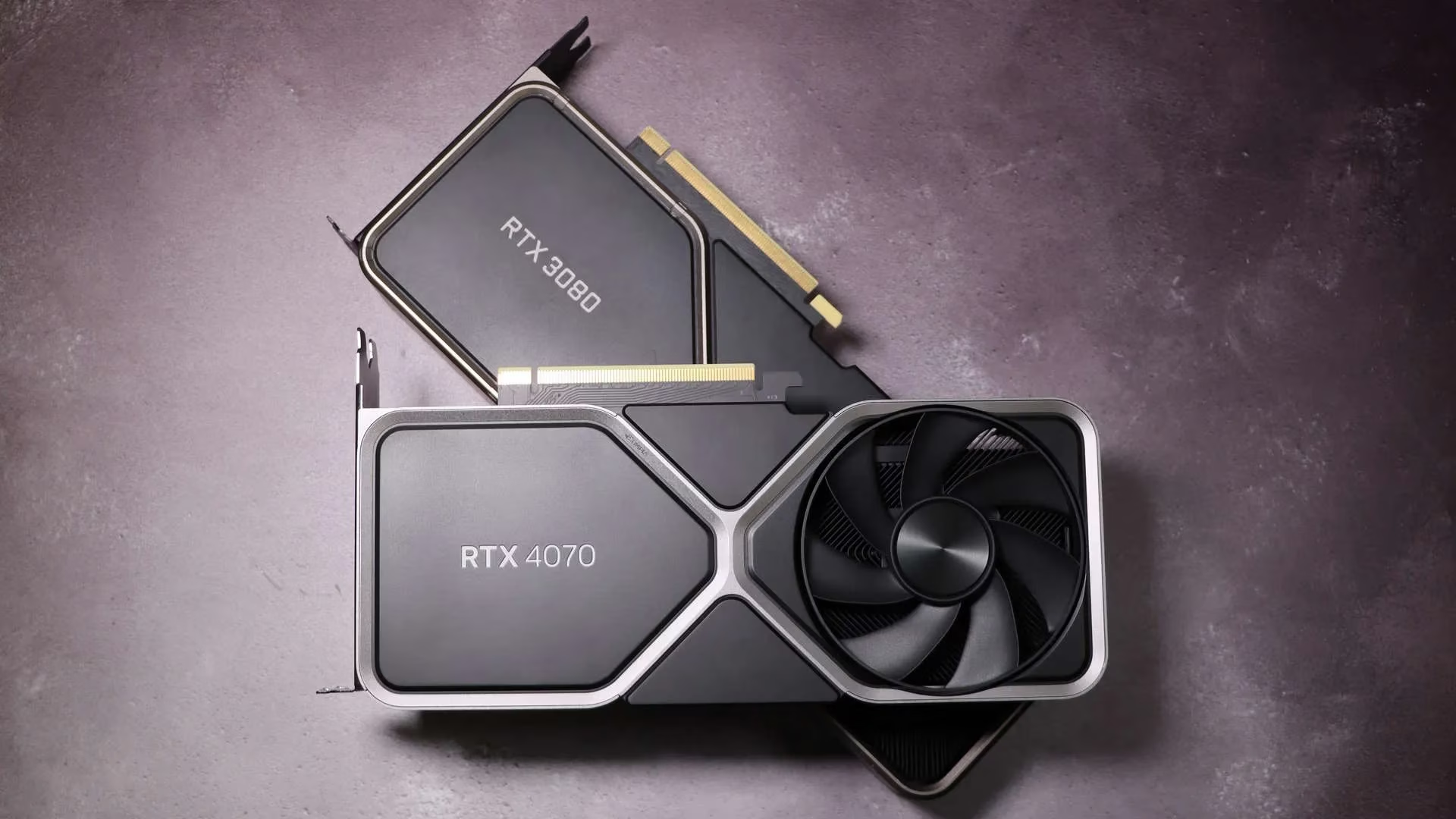
The PC builds at that Major weren’t just a one-piece wonder, of course. Tucked next to that AMD processor was an Nvidia RTX 4080, a graphics card that even in 2026 can handle CS2 like it’s breathing. Banging out frame rates high enough to feed a 360Hz monitor without breaking a sweat? No problem. And speaking of that monitor, the Zowie XL2566K, a 25-inch 1080p TN panel, might raise a few eyebrows among people who’ve gotten used to the inky blacks of OLEDs. But esports logic is simple: until the 0.03ms response time of a new OLED becomes universally affordable and lag-free, the TN panel’s lightning-fast pixel transitions and proven latency remain king. Consistent input lag matters more than contrast ratios when a round can be decided in a single headshot.
PGL’s CEO at the time, Silviu Stroie, said it best: “PGL is committed to providing the best possible competitive environment for the players. By choosing the AMD Ryzen 7 7800X3D for our gaming setups, we’re ensuring that the PGL CS2 Major Copenhagen 2024 will be remembered not only for its intense competition but also for its flawless technical execution.” Those words have aged like a fine wine. Today, whenever a tournament organizer looks back at what made a smooth event, that Copenhagen Major gets cited as a golden example of hardware done right.

Fast forward to 2026, and the 7800X3D still holds its ground ridiculously well. Sure, newer architectures have arrived, and the conversation has started shifting toward what’s next from both AMD and a resurgent Intel, but the sheer value and balanced performance of this CPU remain untouched for pure gaming. It was purpose-built for moments exactly like a CS2 Major—where every tick of the server matters and where the gap between victory and defeat lives in fractions of a millisecond. The fact that the chip was chosen for a $1.25 million prize pool event says everything about its legitimacy. Twenty-four teams, all battling on identical rigs, no one could blame a stutter on their hardware. That’s the dream scenario for any esports player.
What’s even more impressive is how the 3D V-Cache technology trickled down and became a defining feature of AMD’s gaming lineup over the following years. The 7800X3D started a trend that made massive cache pools the standard for high-performance gaming processors. Yet, if you were to grab a second-hand 7800X3D today, pop it into a mid-range motherboard, and pair it with a modern mid-tier GPU, you’d still have a 1080p esports monster that could trade blows with systems costing twice as much. That longevity isn’t something many components achieve. It’s a testament to how forward-thinking that cache design really was.
The monitor choice back then—a 360Hz TN display—remains a talking point. In 2026, 480Hz and even 540Hz panels are slowly creeping onto competitive stages, and the OLED response time advantage is now real and measurable without the crazy price tags of yesteryear. But the philosophy stays the same: pair the fastest CPU you can get with a display that can actually show all those extra frames, and you’ll have a setup that feels telepathic. The 7800X3D, with its ability to push CS2 well above 500 fps at low settings, still doesn’t have a problem saturating those newer monitors, so even if the Zowie XL2566K finally gets retired from tournament use, the CPU it once partnered with won’t break a sweat.
Looking at the broader picture, the PGL CS2 Major Copenhagen 2024 wasn’t just a tournament—it was a hardware demonstration. It proved that thoughtful component selection, especially around the processor and its unique cache, could elevate the entire playing field. For anyone building a competitive gaming PC in 2026, the lessons from that event still apply. You don’t need the flashiest system; you need the right chip, a reliable graphics card, and a monitor that refuses to lag. That formula hasn’t changed one bit, and the Ryzen 7 7800X3D remains one of the safest bets to lock it in. The pros knew it then. They know it now. And if history is any guide, they’ll be leaning on that extra cache for a few more years to come.
Comments