Aim Rogue Inferno revolutionizes CS:GO training with procedurally generated maps, eliminating memorization and forcing tactical adaptation for unprecedented skill mastery.
In the ever-evolving landscape of competitive first-person shooters, Counter-Strike: Global Offensive stands as a titan, its community a perpetual engine of innovation. Amidst a sea of custom skins and traditional map remakes, a groundbreaking creation emerged from the workshop, challenging the very foundations of map memorization and tactical predictability. This innovation, born from the creative mind of OrelStealth, promised not just a new battleground but a near-infinite array of them, reshaping how veterans and newcomers alike approach their training and gameplay.
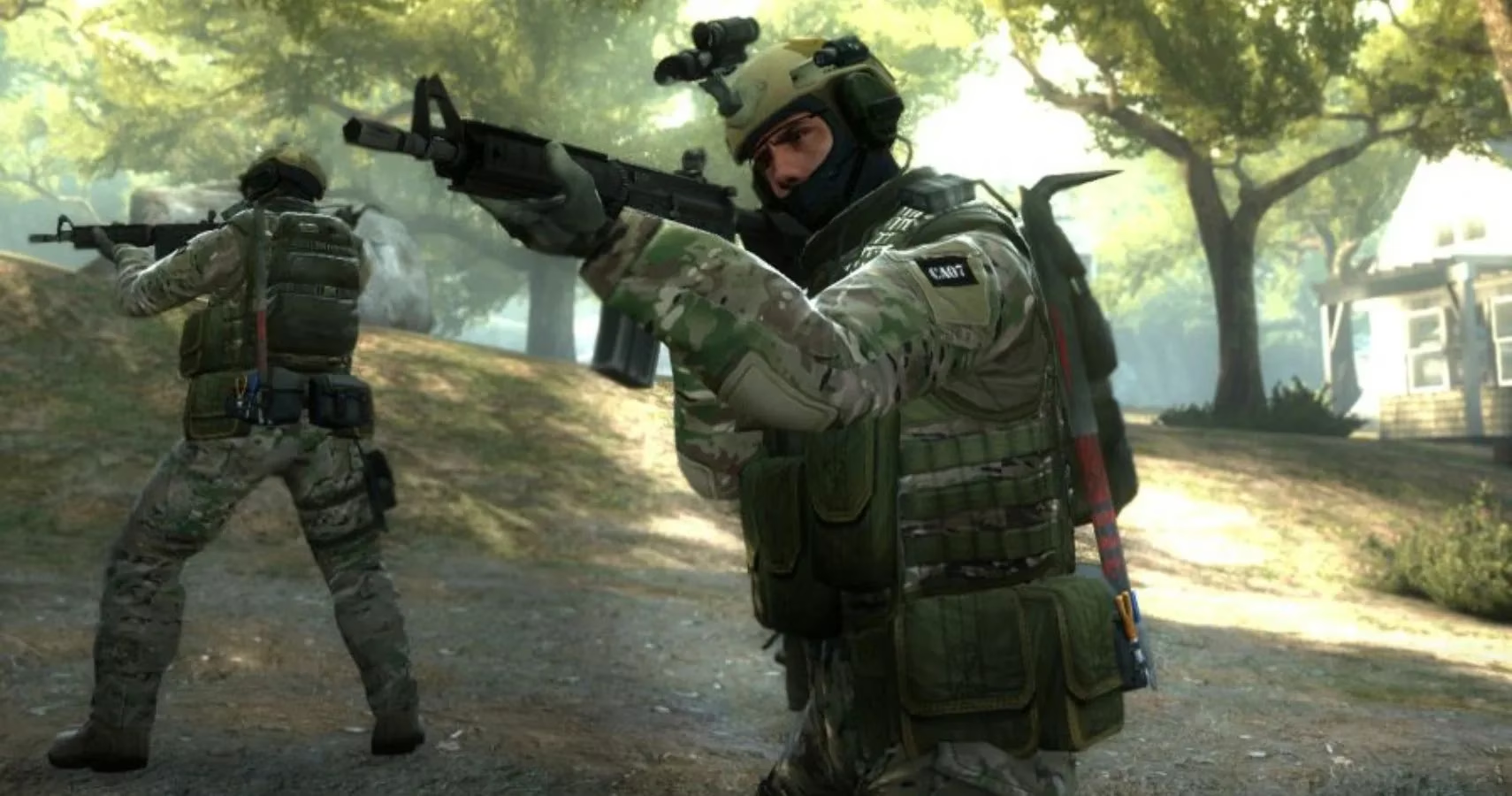
The Genesis of an Infinite Playground
The concept of a procedurally generated environment in CS:GO was not entirely unheard of. OrelStealth himself recalled the early, somewhat divisive experiment with the map "de_havana," where random path closures could frustrate players relying on consistent routes. However, Aim Rogue Inferno was conceived not as a quirky experiment but as a full-fledged revolution. The creator posed a simple yet profound question to the community: What if the entire battleground reshuffled itself every single round? The answer materialized as a map capable of producing "tens of millions" of unique layouts, each constructed from the familiar architectural DNA of the classic Inferno setting—its hallways, rooms, and iconic cover spots—but rearranged by an algorithmic hand.
Mechanics of Mayhem and Mastery
The core appeal of Aim Rogue Inferno lies in its ruthless removal of routine. Each round presents a fresh, unpredictable labyrinth of corridors and chambers. This design philosophy fundamentally alters the player's mental load:
-
🎯 Eliminates Layout Memorization: No more relying on muscle memory for pixel-perfect smoke throws or pre-aiming common angles. Every engagement is a new puzzle.
-
🧠 Forces Tactical Adaptation: Players must constantly scan, assess, and react to their new surroundings, sharpening game sense and improvisational skills.
-
⚙️ Unprecedented Customization: The map offers powerful control over its own chaos. Players can select the generation type to suit their training needs:
| Generation Type | Description | Best For |
|---|---|---|
| Non-Symmetrical | Completely random, organic layouts. | Raw aim and reflex testing under unpredictable conditions. |
| Symmetrical | Mirror-image layouts for both Terrorist and Counter-Terrorist sides. | Fair, duel-style aim practice and symmetrical strategy drills. |
| Half-Symmetrical | A blend of predictable structure and random elements. | Balanced training that mixes known angles with new challenges. |
Furthermore, the inclusion of bot navigation support and seed-sharing functionality elevated it from a mere novelty to a serious training tool. Community members could share and replay specific, challenging layouts by exchanging seeds, fostering a new form of collaborative skill development.
A Community's Verdict and a Shifting Meta
The release of Aim Rogue Inferno was met with widespread acclaim from the CS:GO faithful. OrelStealth and their team had aimed to create something "bigger and better" than any workshop map before it, and the consensus was clear: they had succeeded spectacularly. It was dubbed a "haven for target practice" and the ultimate tool to "brush up your skills in sharpshooting." The map didn't just test aim; it forged adaptable, thinking soldiers.
This innovation arrived during a period of significant change for the game. In a parallel development that puzzled many, Valve's updates around that time removed a long-standing, if sometimes controversial, feature: the bots that would automatically substitute for players who disconnected or performed poorly in matches. While never officially confirmed, the community widely speculated this was to prevent exploitation in the competitive matchmaking system, where a skilled player might replace a bot and unfairly swing a match. This shift towards a purer, player-driven experience contrasted with the workshop's push towards AI-driven, customizable practice environments like Aim Rogue Inferno.
The Legacy and Future of Dynamic Arenas
As of 2026, the legacy of Aim Rogue Inferno is undeniable. It proved that even in a game built on decades of map knowledge, there was a hungry appetite for controlled chaos. It inspired a wave of similar procedurally-influenced training maps, though few matched its scale or polish. The map remains a testament to the CS:GO community's boundless creativity and its relentless pursuit of self-improvement. It serves as a powerful reminder that mastery isn't just about knowing every corner of Dust II; it's about possessing the fundamental skills to conquer any corner, anywhere, under any circumstances. In a world of static arenas, OrelStealth built a living, breathing proving ground that continues to challenge shooters to think faster, aim truer, and adapt or perish.
Comments