Valve's new Dust 2 crate stack lets solo CTs reach catwalk, igniting a firestorm of CS2 community debate over strategic depth.
On a quiet Tuesday in the summer of 2024, Valve dropped a patch note that many scrolled past without a second thought. "Modified crate stack outside CT spawn towards bombsite A" on Dust 2. The understatement was almost poetic. Within hours, the Counter-Strike 2 community erupted into a frenzy of fiery forum posts, anguished tweets, and YouTube breakdowns that called the move everything from a casual-friendly buff to the death knell of strategic play.
The change itself was deceptively simple. For two decades, Counter-Terrorists spawning on Dust 2 had relied on a teammate to boost them onto the catwalk, a critical upper path leading toward A site. It was a ritual as old as the map itself—a quick two-player boost that shaved precious seconds off defensive rotations. The new crate stack allowed a lone player to jump up and access catwalk without help. Suddenly, the shortcut was open from any angle, at any time, and for anyone with a bit of movement skill.
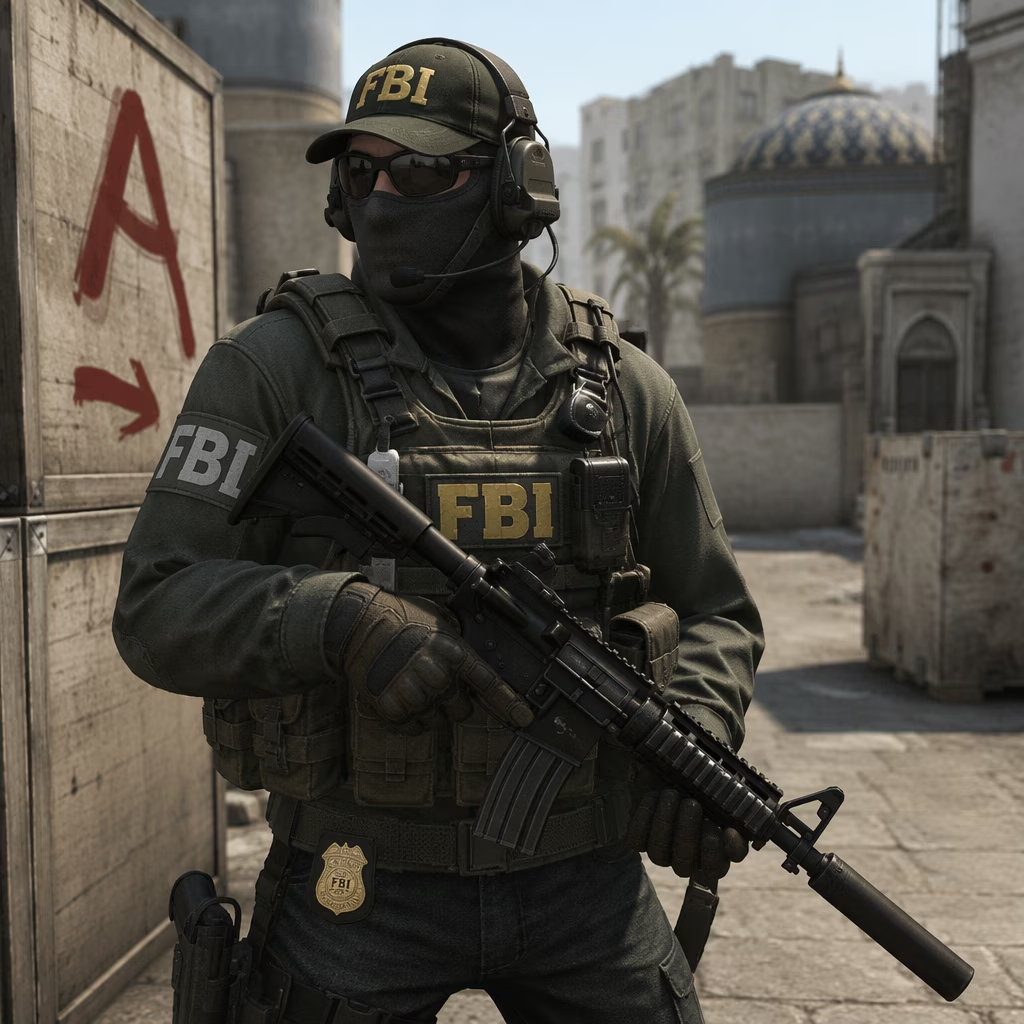
At first glance, it seemed like a quality-of-life improvement. No more awkward pauses waiting for a random teammate to boost. No more miscommunication when a player ignored the call. Yet the hardcore faithful saw only erosion. The competitive fabric of Dust 2, already strained by years of meta shifts, had been torn a little further. The angry voices were loud. "They just broke Dust 2 wtf," one player wailed on Reddit. Another insisted that "against good teams, D2 is going to feel so oppressive on T side," predicting endless mid-pressure and a stranglehold on long A. The most extreme critics traced a crooked line from a stack of crates to the entire franchise's decline, with comments like "Valve is killing this game" mushrooming across every Counter-Strike forum.
Amid the noise, cooler minds urged patience. "Let's see how it plays first?? You guys are allergic to change lol," wrote one sage observer, reminding everyone that Mirage's once-controversial window jump had eventually become a beloved staple. But logic rarely calms a community starved for content. Since Counter-Strike 2's launch, players had been waiting for an operation, new weapons, or the sweeping content drops that once defined Global Offensive. Instead, they got stability fixes, subtle map tweaks, and a persistent cheater problem that felt like background radiation. Every small change became a lightning rod for deeper frustrations.
A peculiar dynamic emerged. The crate rework was simultaneously dismissed as trivial and condemned as game-breaking. In the first weeks, some players discovered creative retake scenarios where CTs could reclaim A site from unexpected vertical angles, while Ts learned to exploit the same shortcut to flank rotating defenders. Pro teams adapted, as they always do, weaving the new route into their playbooks. A few tournaments saw spectacular clutches born from that lone jump onto catwalk. Gradually, the outrage cooled. By late 2024, the modified crates were no more controversial than any other part of Dust 2's storied history of adjustments.
Fast-forward to 2026, and the Dust 2 crate stack has become a footnote—a moment that encapsulates Valve's careful, conservative stewardship of Counter-Strike 2. The game has evolved, but not explosively. Operations finally arrived, though at a trickle. Community servers still buzz with classic maps and workshop creations. The pro scene thrives, and Dust 2 remains the most played battlefield, its sandy corridors now carrying the faint memory of a thousand crate-boost debates.
Yet the scars of that summer patch never fully healed for some. A survey of veteran players in 2026 reveals a split: half barely remember life before the solo jump, while others still grumble that the change robbed the map of its team-first soul. It's a reminder that in Counter-Strike, the smallest alterations can echo for years. A stack of crates is never just a stack of crates. It's a vessel for nostalgia, identity, and the delicate alchemy of competitive fairness.
Valve's approach has remained inscrutable. The developer rarely explains its vision, leaving the community to fill the void with grand theories. By late 2025, a major anti-cheat overhaul had silenced some detractors, but the longing for a golden era of content never goes away. And so, whenever a fresh update touches a beloved map, the old refrain begins again. The crates on Dust 2 might be settled science now, but somewhere, a developer is considering another tweak to a different stack, a different angle, a different sacred cow. And the cycle will spin on: outrage, adaptation, nostalgia, and finally, the quiet acceptance that Counter-Strike, for all its static surfaces, is a living, breathing monument to change.
Even the most cynical voices have a hard time denying the game's longevity. Global Offensive, long after its standalone sunset, still breaks player records on nostalgic weekends. CS2 has cemented its place as the flagship tactical shooter, packing millions of concurrent players. The Dust 2 catwalk shortcut, once a symbol of alleged developer disconnect, now stands as just another path—trodden by millions of boots, its drama long since faded into the background noise of endless matches.
Perhaps that's the real lesson from the crate stack saga. In a game where milliseconds matter and muscle memory is sacred, players cling to every pixel of familiarity. Change feels personal. But time has a way of smoothing even the roughest edges. By 2026, that solo jump to catwalk is as natural as reloading an AK-47. And somewhere, a new player learns it for the first time, never knowing the storm it once caused.
Comments