Esports arena events and live fan engagement have triumphantly returned, creating electrifying, immersive experiences in 2026.
In 2026, the roar of a live crowd at an esports arena is no longer a nostalgic memory but a vibrant, pulsating reality. Looking back, the announcements in late 2021 for The International in Romania and the PGL Major in Sweden were not just isolated events; they were the first, cautious steps on a long road back to normalcy. These pioneering tournaments, mandating vaccinations and masks, served as critical proof-of-concept events. They demonstrated to the entire industry that with careful planning and strict protocols, the magic of live fan engagement could be safely reignited. Who could have predicted that these initial experiments would pave the way for the spectacular, sold-out global circuits we witness today?
The journey from empty studios to packed stadiums was neither quick nor linear. For years, the esports world had adapted to a new normal. Prestigious events like the League of Legends World Championships soldiered on, but the absence of international fans and the eerie silence in arenas created a palpable void. Some scenes faced even greater challenges. The Fortnite World Cup, a spectacle that captivated the world in 2019, was forced into a prolonged hiatus for both 2020 and 2021, unable to build on its explosive debut. While Epic Games pivoted to online competitions to keep its competitive spirit alive, the lack of a live, global championship stalled the scene's momentum. For organizers without a long-established esports infrastructure, the logistical and financial hurdles of hosting a safe in-person event during the pandemic were simply too great.
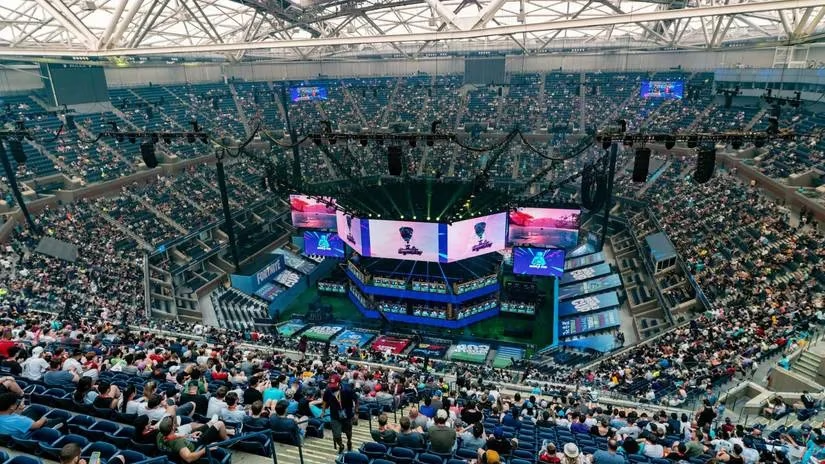
The successful execution of The International and the PGL Major in late 2021 became the blueprint. They carried a heavy responsibility: to lead by example. Their success without major safety incidents sent a powerful signal across the industry. It proved that safe, large-scale gatherings were feasible, at least within regions with robust public health measures. This was the catalyst. Throughout 2022 and 2023, other tournaments cautiously began reintroducing live audiences, often starting with limited capacity before scaling up.
Fast forward to 2026, and the landscape is utterly transformed. The lessons learned from those early days have evolved into sophisticated, integrated fan experience models. Today's major tournaments are hybrid spectacles of unparalleled scale:
🎮 The Live Experience Reimagined:
-
Global Fan Tours: Events like The International and the LoL Worlds are now multi-city, multi-country festivals, with fan zones and auxiliary events in major cities worldwide, connected via holographic viewing parties.
-
Immersive Tech Integration: Augmented Reality (AR) overlays in venues allow fans to see real-time stats, player perspectives, and dramatic effects over the live action. Haptic feedback seats in premium sections sync with in-game explosions and abilities.
-
Health & Safety 2.0: While mandatory vaccinations are a thing of the past, venues employ advanced, non-intrusive air filtration systems and touchless concession stands as a standard. Real-time crowd density apps help fans navigate venues comfortably.
📈 The Business of Fandom:
-
Premium Live Packages: Beyond the ticket, fans can now purchase packages that include post-match VR meet-and-greets with players, analytics deep-dive sessions with coaches, and exclusive in-game cosmetic items only available to attendees.
-
Data-Driven Engagement: Organizers use anonymized data from venue apps to tailor concessions, merchandise offerings, and schedule intermission activities, creating a hyper-personalized event experience.
| Era | Fan Presence | Key Challenge | Primary Revenue Driver |
|---|---|---|---|
| Pre-2020 | Packed, global audiences | Logistical scaling | Ticket sales, venue merch |
| 2020-2021 | Virtual only (no live fans) | Maintaining engagement | Digital broadcast rights, virtual merch |
| 2021-2023 | Limited, regional audiences | Health & safety protocols | Hybrid broadcast, limited premium tickets |
| 2026 (Present) | Full, global & immersive | Delivering unique live value | Integrated experience packages, data monetization |
The return of fans did more than just fill seats; it restored the soul of competition. The collective gasp at a stolen objective, the deafening eruption for a clutch ace, the synchronized chants—this raw, human energy is an element that simply cannot be replicated digitally. It elevates player performance, creates legendary moments, and forges deeper emotional connections between teams and their supporters. The canceled Fortnite World Cup of the early 2020s serves as a stark reminder of what was lost. Its eventual return as a physical event in 2024 was a celebration not just of competition, but of community reunited.
So, what does the future hold? The hybrid model is here to stay. The digital broadcast will always be paramount for global reach, but the live event is now its premium, experiential counterpart. The success of 2021's pioneers proved that fans are not just an audience; they are an essential component of the esports ecosystem. Their energy is the fuel that powers the spectacle. As we look ahead, the question is no longer if fans will be there, but how organizers will continue to innovate to make the live experience more immersive, more inclusive, and more unforgettable than ever before. The era of the connected, global, live esports spectacle is fully upon us, and its foundation was laid by those first brave events that decided to open their doors once more.
Comments