Steam Trade Protection enhances security for CS2 skins and Steam items, offering a seven-day reversal window for safer trading.
Imagine a vault where every digital treasure you’ve fought for—a crimson AK-47 skin, a shimmering Karambit knife—sits behind glass. Now imagine a thief slips in, swaps all that glass for thin air, and vanishes. In 2026, Valve’s Trade Protection feature acts as an invisible time-reversal button, a sort of delayed fuse on every transaction, giving victims a full week to hit undo. Launched originally as part of Counter-Strike 2’s tongue-in-cheek Season 2: Episode 1, the system has since matured into a broader shield across the Steam inventory ecosystem, turning the sprawling marketplace into something closer to a monitored gallery where every frame comes with a seven-day alarm.
At its core, Trade Protection is a mechanism that lets any player instantly reverse trades involving protected items within the past seven days. When a trade is confirmed—say, you swap a knife for a rifle—the items land in your inventory and are fully usable in-game. You can equip them, flash them in a match, watch the light play off the digital cerakote. But they carry a subtle digital quarantine tag: for those seven days, the items cannot be consumed, modified, or re-traded. Valve has stamped them as \u201cTrade Protected,\u201d a glowing mark visible in your inventory, like a temporary leash that keeps the asset tethered to the original chain of ownership. Only after that cooldown period does the leash dissolve, and the trade becomes irreversible.
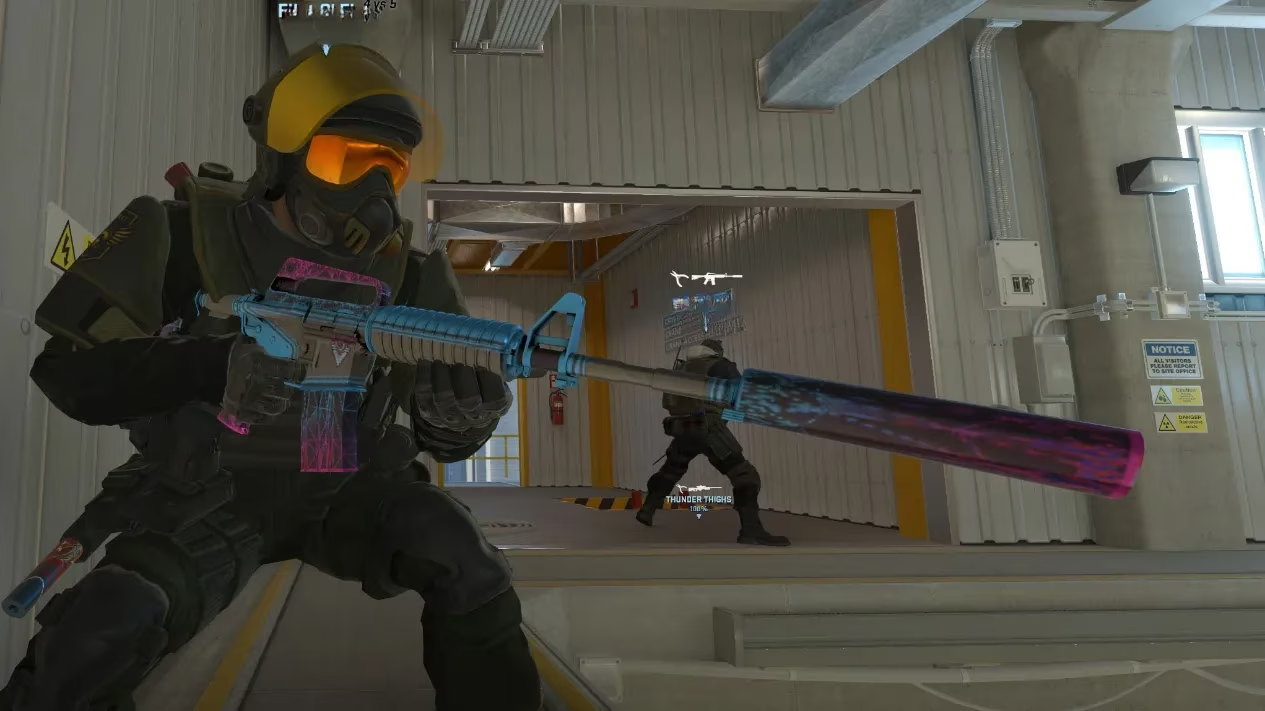
The reversal process feels almost cinematic. A player navigating to their Trade History page sees a list of recent exchanges, each flagged with that protected status. One click on \u201cReverse Trades,\u201d and like rewinding an old VCR tape, every trade containing Trade Protected items unwinds. The skins, crates, and stickers flow back to their previous owners, and the account that triggered the reversal gets slapped with a 30-day trading and Community Market ban. It’s a blunt instrument, deliberately so: Valve’s design philosophy here resembles a financial stop-loss order. If a hacker breaches your account and liquidates your inventory, you don’t need to negotiate with a support ticket queue that might take weeks; you just pull the emergency brake and reset the last week.
But the system isn’t a frictionless paradise. Consider the mixed-bag rule: you can’t bundle Trade Protected items with unprotected ones in a single trade. If you want to swap a CS2 skin (protected) for an item from an older game that hasn’t yet adopted Trade Protection, the trade simply won’t go through. Valve has drawn a bright line—all items in a trade must share the same protection level. This has spawned a secondary effect: a sort of inadvertent segregation in the Steam economy, where protected inventories behave like a parallel currency zone. It’s akin to having two different kinds of water in the same pool, layered but not mixing, forcing users to be hyper-aware of what’s shielded and what’s raw.
Valve’s FAQ, updated as the feature rolled into 2026, now mentions that other games leveraging Steam\u2019s inventory system are gradually flipping the switch. While Counter-Strike 2 remains the flagship—its vibrant skin economy being the primary battlefield—titles like Dota 2 and Team Fortress 2 have started dabbling in partial protection for tournament drops and rare vintage items. The company’s language remains characteristically noncommittal, promising expansion \u201cas we learn more about this.\u201d Yet the very existence of the feature marks a shift in how Valve treats account security: no longer just a reactive fortress of two-factor authentication and recovery codes, but a proactive undo buffer that turns every trade into a tentative handshake.
Critics have raised an eyebrow at the potential for abuse. The reversal button doesn’t ask questions—it doesn’t distinguish between a phishing attack and a player’s sudden remorse after a lopsided deal. A person could trade away a hard-earned M4A4 skin for a set of stickers, regret it an hour later, and reverse everything without proving any malicious intent. So far, Valve has not clamped down on such behavior, though the mandatory 30-day trade lock after a reversal acts as a strong deterrent for frivolous use. It’s a gamble: treat the community like adults, offer a safety net, and accept that some might treat it like a return policy at a department store. But given the stakes—stolen inventories often represent hundreds or thousands of real dollars, with some rare skins fetching over $5,000—the trade-off seems calculated.
Another quirk that often goes unmentioned is the psychological effect on the market itself. The seven-day protected window has introduced a new rhythm to trading. High-value items no longer change hands instantly and irreversibly; they sit in a limbo where both parties know a recall is possible. This has dampened some of the speculative frenzy, turning quick-flipping into a more measured dance. It’s as if every traded skin wears a tiny clock, ticking down, visible only to those who understand the code. For honest traders, the delay is negligible—they still get to use the skin immediately—but for fraudsters trying to wash stolen goods through multiple accounts, the cooldown acts like a sticky web, giving owners precious extra hours to react.
Looking back from 2026, the launch of Trade Protection feels less like a patch note item and more like a quiet revolution in digital property norms. Other platforms have taken notice; whispers among console network architects suggest similar chained-trade reverts are being prototyped. Valve, true to form, rolled it out with a joke about not counting to three, yet the underlying message was serious: your virtual stash now comes with a built-in escape hatch. For anyone who has ever lost a beloved skin to a midnight scam, that seven-day window is not a restriction—it’s a guardian angel folded into code.
As the system continues to mature, one can imagine even smarter layers being added: perhaps AI-driven fraud detection that automatically flags suspicious transfers, or a sliding scale of protection based on item rarity. For now, though, Trade Protection stands as a remarkably simple fix to a complex problem. It doesn’t prevent theft, but it removes the thief’s ability to disappear the loot. And in a world where a digital rifle can cost more than a real one, that\u2019s the closest thing to insurance Valve is ever likely to offer.
Comments