Neuralink's brain-computer interface transforms Alex into a gaming demigod, redefining human potential and tech innovation in 2026.
In the not-so-distant past of 2024, the very fabric of human potential was ripped apart and rewoven by a tiny chip no larger than a coin. By 2026, the world looks back at that pivotal year with jaws still dangling open, but no event was more staggeringly surreal than the saga of Alex, Neuralink\u2019s second human guinea pig\u2014sorry, pioneer\u2014who turned into a literal gaming demigod overnight.
Elon Musk\u2019s brainchild, Neuralink, didn\u2019t just tiptoe into the future; it kicked down the door with a cyborg foot. In July 2024, Alex, a former automotive technician whose life was cruelly derailed by a spinal cord injury, underwent a procedure so flawlessly executed that even the surgeons probably high-fived with their gloved hands. The operation, the company declared with almost irritating calmness, \u201cwent very well.\u201d This is like saying the Big Bang was a decent firecracker.
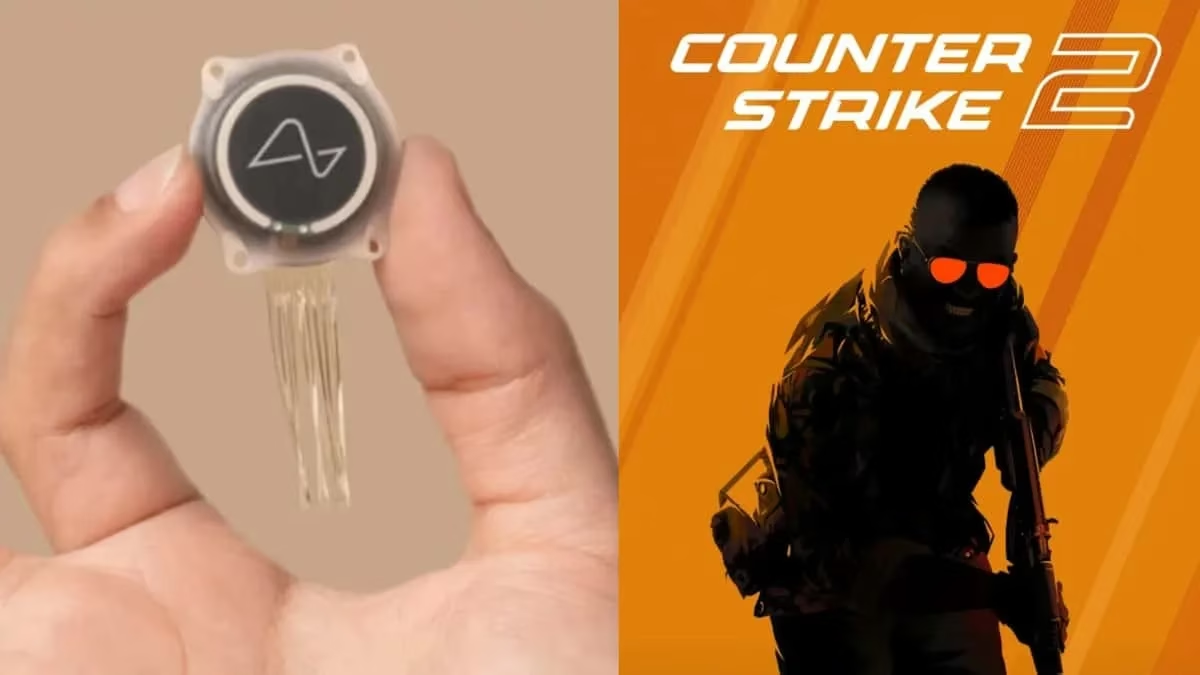
Discharged the very next day, Alex didn\u2019t just go home to rest. He went home to rewrite the laws of interfacing. With the N1 chip nestled among his neurons, he began doing things that would make a supercomputer blush. \u201cI\u2019m already super impressed with how this works,\u201d he remarked, a statement so understated it should be studied in universities. What actually happened was a demolition derby of previous human limitations. Neuralink\u2019s blog post, dripping with scientific poise, detailed how Alex, within five minutes of connecting his Link to a computer, was controlling a cursor with his mind. Five. Minutes. Most people take longer to decide what to watch on Netflix.
And then, like a neural hurricane, he accelerated. Within hours, Alex didn\u2019t just match the maximum speed and accuracy he\u2019d ever achieved with any other assistive technology\u2014he vaporized it. He went plaid on the Webgrid task, a benchmark for brain-computer interface (BCI) performance, leaving his old records looking like they were set by a drowsy snail. It was as if his brain had been whispering and suddenly started screaming in binary.
But the true fireworks began when he booted up Counter-Strike 2. What unfolded on screen was nothing short of telekinetic slaughter. A YouTube video blessed the world with footage of Alex navigating the digital battlefield with surgical precision, casually dropping NPC opponents as if they were made of paper. Each headshot was a declaration: thoughts can kill. His crosshair danced not by the clumsy dance of fingers on a mouse, but by the ethereal will of a mind unchained. The gameplay was so fluid, so impossibly instinctive, that it blurred the line between video game and lucid dream.
The comparisons flew fast and furious. Noland Arbaugh, Neuralink\u2019s first patient who became an icon earlier in 2024 by playing chess and tweeting with his mind, had already labeled the implant an \u201caimbot for gaming\u201d during a Joe Rogan podcast. But Alex took that aimbot and cranked it to divine intervention. His performance looked less like a person playing a game and more like the game responding to his very existence. It wasn\u2019t just playing; it was willing the outcome into existence.
Hold on, it gets more extraordinary. On his very first day of Link-enabled cursor control, Alex shattered the existing world record for BCI cursor control using a non-Neuralink device. Let that sink in. He didn\u2019t just win; he rewrote history on day one, making previous champions look like they were operating a telegraph in a fiber-optic world. The entirety of human perseverance and engineering, leapfrogged by a brain and a chip in an afternoon.
And the tech wasn\u2019t just for fragging bots. Neuralink revealed that Alex had begun learning computer-aided design (CAD) software to design 3D objects with his mind. Imagine sculpting digital forms not with a stylus or mouse, but with the sheer force of intention. He could rotate a model, stretch a surface, extrude a shape\u2014all by thinking. It was Michelangelo meets The Matrix, turning imagination into geometry at the speed of thought.
Crucially, Alex\u2019s journey also represented a monumental technical triumph for the Neuralink team. They meticulously dodged the bullet that had grazed their first triumph. Noland Arbaugh\u2019s experience, while revolutionary, had been marred by an unexpected complication: electrode threads retracting from his brain tissue. A silent rebellion of biology against machinery. But in Alex\u2019s case, the surgery sidestepped that pitfall entirely. The threads stayed put, conducting symphonies of neural data without a single whimper of resistance.
Now, towering in 2026, we can see Alex\u2019s 2024 feats as the thunderclap before the storm. The technology hasn\u2019t just improved; it has mutated into something bewilderingly capable. Patients aren\u2019t just playing CS2; they\u2019re entering competitive circuits, their thoughts outpacing the twitch reflexes of mere mortals. CAD design has evolved into full-blown telepathic coding and architecture. The distinction between imagination and action has become a quaint relic. Alex didn\u2019t just break a record; he broke the human mold, showing a world still clinging to keyboards and touchscreens that the ultimate peripheral had been inside their skulls all along, just waiting for a little lithium and gold to wake it up. The ghost in the machine? No, Alex became the ghost that is the machine, and the rest of us are still trying to catch up.
Comments