Counter-Strike 2 Train map update and community maps revive classic gameplay with stunning visuals and fresh tactical depth.
I still remember the day the whistle of a phantom locomotive stirred the servers. It was November 13, 2024—almost two years ago now—when Valve, in one of their quiet, knowing moments, brought back the map that had taught generations how to hold an angle, how to listen for the clatter of boots on metal, and how to die beautifully in a corridor of crates. Train returned to Counter‑Strike 2 not as a carbon copy of the past, but as a memory polished into a luminous, rain‑slicked gem.
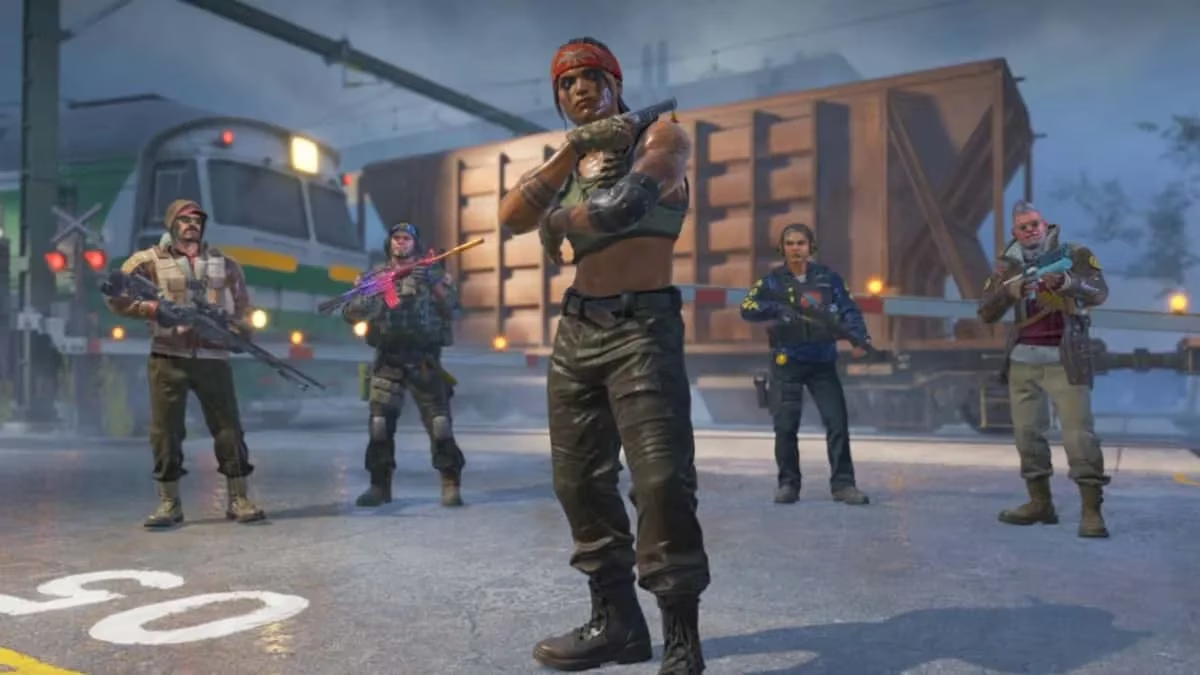
When the patch notes dropped that autumn morning, I was not the only one who felt a quiet thrill. After fourteen months of dribbled content from the original Counter‑Strike, the dev team had finally delivered a cornerstone. The Armory and even weapon charms had arrived in earlier updates, but for many of us, a shard of our soul had been pining for the long corridors, the pop‑flash A site, and the manic rush down Ivy. Valve’s tweet, as modest as ever, read: “A map almost as old as Counter‑Strike itself returns.” How do you pack decades of clutch rounds, shouted callouts, and heartbreak into a single sentence? You don’t—you let the map do the talking.
The Renaissance of an Icon
Train in CS2 was not a lazy port. The patch notes gently warned veteran players not to expect an exact recreation. And how true that was. The core geometry remained sacred—three lanes, the inner bomb train, the outer warehouses—but the touch of Source 2 had turned every surface into a story. Puddles reflected muzzle flashes; smoke curled with a physical weight that mirrored the gravity of a round. The light now bled through dusty windows as if the sun itself were a spectator. In my first competitive match on the new Train, I found myself pausing mid‑round simply to marvel at the way a grenade’s echo cascaded through the rafters. Was this the same map I had rushed a thousand times in CS 1.6? Yes and no. It was older and wiser, like a friend who’d travelled the world and returned with new stories but the same laugh.
That initial update surprised players not only with Train’s return but with a handful of map tweaks that breathed life into the rotation. Overpass, that labyrinth of verticality and water, received subtle layout adjustments—a widened bench area, a shifted pillar near monster, details small enough to go unnoticed unless you were the one clutching a round at 14‑15. Valve knew exactly how to keep even the most attentive fans “on [their] toes.” And isn’t that the soul of Counter‑Strike? Constant evolution wrapped in familiar ritual.
A Blossoming of Community Maps
Beyond the official touch‑ups, that November update seeded the future with four community‑crafted maps. For the intimate duels of Wingman, Palais and Whistle offered tight, personality‑rich arenas where every footstep told a tale. In casual and competitive queues, Basalt and Edin unfolded like letters from mapmakers who understood the rhythm of the game better than any algorithm. Ever since, these maps have blossomed into staples. Today, in 2026, I see Basalt picked almost as frequently as Mirage, its volcanic‑rock corridors now as iconic to a new generation as Dust II’s double doors were to mine. Edin’s rainy streets, meanwhile, have become my personal sanctuary for late‑night pugs. Did anyone foresee, on that unassuming November day, that community contributions would one day rival official designs in popularity?
The patch notes for November 13, 2024, were remarkable for what they didn’t contain. No weapon balance tweaks, no bug‑fix bullet points, no grand system reworks. Just maps. And perhaps that was the message: after seasons of Armory hype and meta upheavals, Counter‑Strike needed to remember where it came from. The game’s soul is not in the kill‑feed numbers but in the spaces where those kills happen. A perfectly balanced rifle means nothing without a corridor that tests your courage. Those silent weeks before the update had felt like a lull, but now I see they were the quiet before a locomotive roared back to life.
How the Rails Shaped the Present
Looking back from 2026, the Train revival marked a turning point. It showed that Valve’s commitment to CS2 wasn’t just about flashy skin milestones or operation gimmicks—it was about honoring the bedrock. In the years since, Train has received further refinements: a slight widening of the connector on A site to reduce the “funnel of death,” a few more props in the brown halls to break up long sightlines. Each change arrived without fanfare, tucked inside smaller blog posts, yet every single one sent ripples through the competitive scene. I recall a Major semi‑final in 2025 where a team’s Train prowess became the stuff of legend, their executes on the outside bombsite so precise they seemed choreographed.
And what of Overpass? That gentle face‑lift in 2024 was just the beginning. Overpass has since become the canvas for some of the most creative utility in the game, its playground‑like structure inviting innovation every season. Meanwhile, the once‑novice community maps matured into full‑fledged arenas that hosted their own tournaments. I wonder, sometimes, if the designers of Palais ever imagined their creation being played in front of millions on a Grand Final stage.
Riding the Loop
The train never truly stops—not in the game, not in our memories. When I queue into CS2 today and hear my teammates call out a push on “old bomb” or “pop dog,” I’m transported not to a specific moment but to a continuum of moments, from 2003 to now. The November 13 update was more than a map drop; it was a restoration of faith. It whispered that even in a world of ever‑evolving graphics and business models, some things are worth carrying forward, polished but unbroken.
So here I am, in 2026, still learning new smokes on Train, still getting knifed in the back on Whistle, still heart‑racing on Basalt. The game around me changes, but the feeling of planting a bomb under the ticking clock of a locomotive remains eternally young. Did we ever doubt Valve would bring Train back? Perhaps for a moment. But like the iron beast itself, some legends just keep arriving, right on time.
Comments