Counter-Strike 2, the competitive FPS sequel to CS:GO, brings groundbreaking gameplay changes and a new era for professional players.
September 27, 2023. I still remember refreshing my Steam library and seeing Counter-Strike: Global Offensive vanish. In its place, a brand new tile: Counter-Strike 2. No option to launch the old client, no extended farewell tournament—just a seamless, irrevocable replacement. I had spent thousands of hours in CS:GO, and suddenly it was a memory, absorbed into Valve’s Source 2 engine successor. That day, the competitive FPS landscape shifted beneath our feet, and as a professional player, I felt a wave of both excitement and dread.
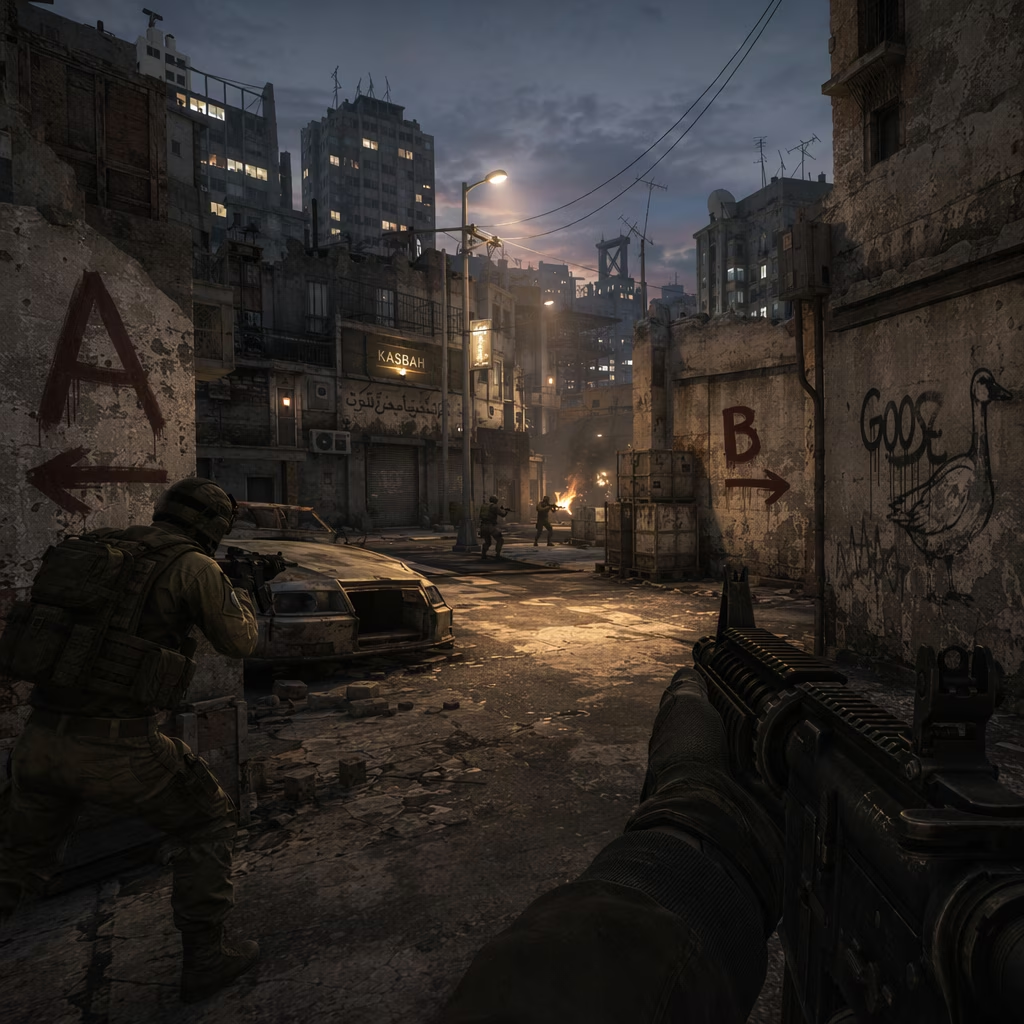
The transition was anything but quiet. Valve marked the occasion with a tongue-in-cheek GIF of a crying emoji behind the CS:GO logo, a digital tear for a legendary game that had dominated the charts for over a decade. CS:GO servers shut down, and CS2 rose from its ashes. The core promise? All our beloved skins, stickers, and knives carried forward—but the gameplay felt alien. Volumetric smoke, tickless servers, Source 2 lighting—minor patch notes in other titles, maybe, but earth-shaking in a game where a single pixel of visibility could decide a Major final.
I booted up CS2 that first evening with a mix of curiosity and skepticism. The visual overhaul was immediate. Mirage’s palace windows now gleamed with physically-based rendering; Inferno’s tight corridors felt cleaner yet more oppressive under the new lighting. The audio reworks made footsteps crisper, but the most jarring change was the smoke grenade. Toss a smoke, and instead of a static gray wall, a swirling volumetric cloud billowed across the bombsite, reacting to bullets and grenades alike. You could carve temporary sightlines through the smoke with a well-placed HE grenade. Had any update ever so fundamentally altered the strategic DNA of Counter-Strike? I doubted even the developers could foresee every consequence.
In those early weeks, the pro scene echoed my unease. In a survey just before launch, fellow competitor Héjja “kezziwow” Kászandrá confessed, “It’s not competitive-ready at all, I still rather play CS:GO.” Another pro, Sebastian “volt” Maloș, admitted, “If I had to choose right now I would still go for CS:GO.” These weren’t casual quick-play warriors; these were players whose livelihoods depended on split-second reactions and map knowledge etched into muscle memory. Could a free-to-play sequel truly honor that legacy?
Three years later, standing here in 2026, I can barely recognize my old doubts. Counter-Strike 2 matured with a velocity no one anticipated. The tickless server architecture—initially blamed for hitreg anomalies—now delivers some of the smoothest gunplay I’ve ever experienced. Sub-tick movement and shooting mean my inputs register at the exact moment I press them, not constrained to legacy tick rates. The “CS Rating” leaderboard replaced the opaque numerical ranks with a dynamic, seasonal system that finally rewards consistency across solo queue and team play. I’ve climbed to the Global Elite tier, but the journey felt more transparent and merit-based than in CS:GO’s twilight.
Volumetric smoke, once my greatest frustration, became my favorite tool. Mastering its behavior—how it seeps around corners, lifts with a molotov’s heat, or disperses under a spray of bullets—introduced a new dimension to mind games. Who would have thought that a simple grenade could become a canvas for tactical artwork? On Ancient, I now call for a double smoke setup that creates a temporary hallway, baiting opponents into an awp angle they never see coming. It’s a level of spatial manipulation the old fixed smokes could never provide.
Of course, not every change sailed smoothly. The updated maps polarized the community. Dust 2 remained a touchstone, largely unchanged, but many competitive maps like Overpass received significant visual and structural reworks. Sometimes I miss the gritty, dim corridors of old Train or Cache, but the competitive map pool today—including Mirage, Inferno, Nuke, Anubis, and two newly added classics—feels vibrant and watchable for spectators. Majors in this era break viewership records quarterly; the last one peaked at over 2.5 million concurrent viewers on Twitch and Steam.tv.
What about the players who resisted? Valve, perhaps learning from the Overwatch 2 backlash, kept previous Counter-Strike builds available (1.6 and Source still have their niche communities), but CS:GO is truly gone. The transition felt brutal at first, but the unified playerbase on a single modern engine has turbocharged the esports scene. Prize pools swelled, organizations stabilized, and the talent pipeline from Faceit and ESEA into tier-1 never ran stronger.
Looking back, I ask myself: would an optional split between CS:GO and CS2 have diluted the playerbase and delayed innovation? Probably yes. Path of Exile’s decision to keep both games alive works for an action RPG, but a competitive shooter thrives on a single, definitive version. The “mutated sequel” model that damaged Overwatch 2’s reputation succeeded here because Valve refused to compromise on the fundamental fairness—our skin inventories were safe, and the core 5v5, economy-based gameplay remained untouched beneath the new paint.
As I queue for another Premier match on a crisp 2026 evening, I smile remembering that anxious September day. Counter-Strike 2 no longer feels like a forced replacement; it is the natural evolution of a timeless formula. The volumetric smoke swirls across the screen, my team coordinates through the reworked audio, and the sub-tick system registers a clean headshot. Is this the same game I played a decade ago? In spirit, absolutely. In execution, it’s better than I ever dared hope.
Comments