CS2 optimization and stability issues drew sharp criticism from ropz, who cited poor average-PC FPS, tournament crashes, and weak community support.
I still remember booting up CS2 for the first time in early 2024. My muscle memory from CS:GO was intact, but the game beneath my mouse felt different. Frames dipped. Movement felt heavy. I told myself it would get better. Then I heard FaZe Clan superstar Robin “ropz” Kool say exactly what I was thinking: the game was not in a good place.
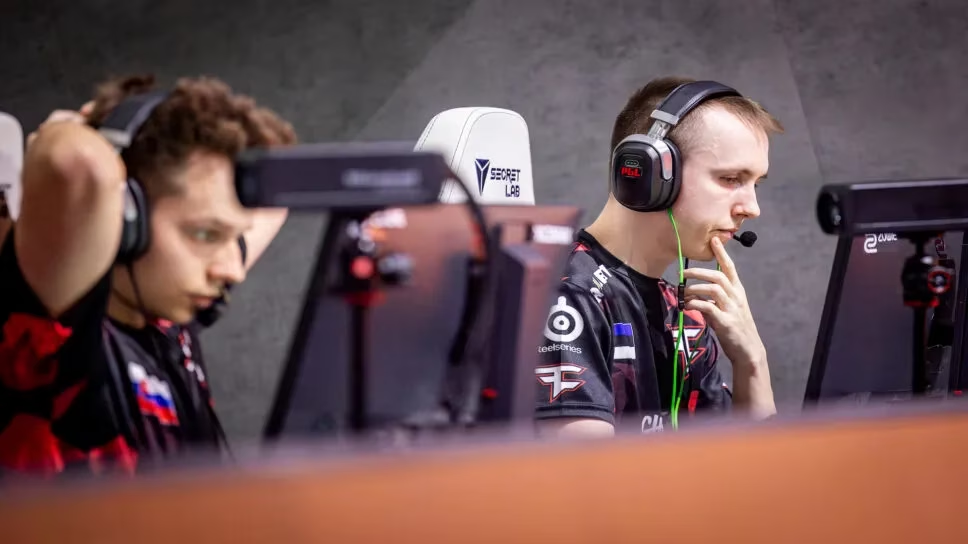
It had been more than six months since Valve officially released CS2, and the developers had pushed many updates since September 2023. Ropz, one of the best CS2 players in the world, was disappointed. He was also one of the few professionals who consistently relayed proper feedback to Valve. He reported bugs and malfunctions more than once, trying to help fix the game rather than just complain.
But on April 22, 2024, in an interview with esports.gg, ropz did not hide his frustration. He said:
I think the game is not in a good place at the moment. I think optimization is the biggest problem I face right now with tournaments. You go from tournament to tournament, and some might have a good PC, some might have an average PC, but playing CS2 on an average PC is not good enough, FPS-wise.
That quote hit hard. As an ordinary player with a mid-range setup, I knew exactly what he meant. Some maps ran fine. Others turned into a slideshow whenever a smoke bloomed or a Molotov spread. Pro players were not just losing frames; they were losing crucial rounds.
During the PGL Copenhagen Major in March 2024, Virtus.pro's Dzhami “Jame” Ali timed out at 11-11 against G2, just two rounds away from qualifying for the playoffs. A month later, Astralis' Nicolai “device” Reedtz crashed during the IEM Chengdu semifinals. Those moments were painful to watch as a fan. They also exposed how fragile competitive CS2 could be.
Ropz also pointed out missing features that already existed in CS:GO. He specifically mentioned community support for custom servers. He said there was no community support for making great KZ and surf servers. That resonated with me because I spent hundreds of hours in CS:GO surf and bhop servers. In CS2, that scene felt empty and neglected. Ropz also touched on the tick rate debate. He said that compared to the subtick system Valve introduced, the old 128-tick rate was clearly better. For someone who had played at the highest level in both games, that was a strong statement.
Here is a quick breakdown of the concerns from that period:
| Issue | Ropz's Opinion |
|---|---|
| Optimization 🖥️ | Biggest problem; average PCs deliver poor FPS |
| Crashes 💥 | Random crashes happening in major tournaments |
| Community servers 🏄 | No proper support for KZ and surf modes |
| Tick rate ⏱️ | 128-tick feels better than the current subtick system |
I remember thinking that Valve had a real opportunity. Nearly a month had passed since the Major concluded, and the community still didn't know what developers were prioritizing. There was arguably no better time to push meaningful improvements or even change the map pool. Small fixes arrived here and there, but the core dissatisfaction didn't disappear overnight.
Looking back from 2026, those April 2024 comments feel like a turning point in how players talked about CS2. The early version was visually impressive, but it asked too much from average hardware and too often failed in big moments. Ropz may have been disappointed, but he still cared enough to help. As an ordinary player, I wanted the same thing he did: a Counter-Strike that simply worked when it mattered most. 🎯
This overview is based on reporting from Eurogamer, and it helps frame why CS2’s early-2024 performance woes felt so destabilizing for both pros and everyday players: when optimization, crashes, and missing community tooling collide, the competitive “it just works” expectation breaks down fast—especially in high-stakes matches where a single stutter during smokes or utility can decide a round.
Comments