Valve's shift from solitary single-player games like Half-Life to a multiplayer-focused future, as signaled by Portal 2's co-op, redefines its legendary design philosophy.
The echoes in the test chamber have grown fainter. Last week, as I guided Chell through the final, brilliant puzzles of Portal 2, I felt a profound sense of completion, not just for the game, but for an era. The cake, it seems, is no longer a lie meant for one. The companion cube in my memory now has a twin, for the game’s standalone co-op mode wasn't just an addition; it felt like a herald. Valve, the architect of so many of my solitary digital journeys, is whispering a new directive into the sterile air of its laboratories. The future, they say, is built for more than one.
Valve is no stranger to crafting shared spaces. I remember the frantic, joyous terror of Left 4 Dead, where a friend’s cry of "Tank!" was a bond stronger than any blood pact. The endless, ever-evolving carnival of Team Fortress 2 has been a home for a decade, its hats and hijinks a language we all speak. And the tense, precise dance of Counter-Strike defined an entire genre of shared competition. These were not just games; they were communal hearths. So, when Gabe Newell suggests Portal 2 might be their last with an "isolated single-player experience," the statement doesn't shock me—it resonates with a deep, pre-existing hum in their design philosophy.
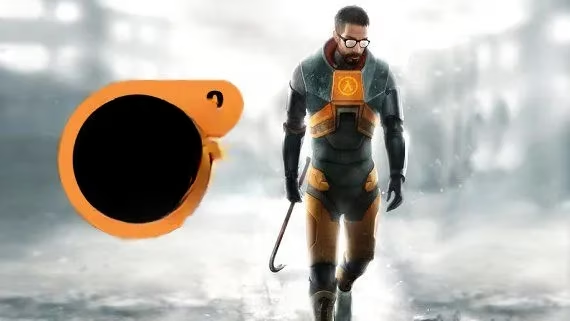
Yet, the resonance creates a dissonance in my heart. What of City 17? What of the silent, bespectacled physicist who started it all? The Half-Life series is the lonely cornerstone upon which my love for Valve was built. To think of that universe devoid of Gordon Freeman’s singular, wordless struggle feels... wrong. The rumors of a next installment have been ghosts in the system for years. Does this new focus mean we must finally lay those ghosts to rest?
I don't believe so. The silence from the Lambda Complex isn't a death knell; it's a recalibration. I imagine the next chapter not as an end, but as an expansion. Perhaps Dr. Freeman will finally have a partner in the resonance cascade, a co-op companion to share the weight of the crowbar and the burden of saving worlds. Or maybe the streets of City 17 will become a new arena, where teams compete in a brutal, physics-driven struggle between the Resistance and the Combine. The thought is neither comforting nor alarming—it is simply inevitable, a logical progression of the path Valve has been walking for years.
My mind wanders through the possibilities:
-
A Co-Op Campaign: Alyx Vance, no longer just a voice in your ear, but a tangible presence, solving environmental puzzles that require two sets of hands, covering angles in firefights no one could manage alone.
-
A Competitive Multiplayer Mode: Rebels vs. Combine, using gravity guns, pheropods, and strider-busting weaponry in objective-based battles across iconic locations.
-
A Persistent World: A bold, new direction—a shared, evolving Half-Life universe, where players contribute to a collective narrative against the Universal Union.
The landscape of 2026 is fundamentally interconnected. The games that linger in our culture are not those we finish alone, but those we experience and reshape together. Valve has always been a mirror to gaming's zeitgeist, and their pivot feels less like an abandonment and more like an acknowledgment. They are not closing the book on storytelling; they are inviting more authors into the room.
So, I look back at the empty test chamber one last time. I am grateful for the silence it gave me, the profound puzzles that were conversations between my mind and the machine. But I also turn towards the noisy, vibrant, unpredictable spaces where my friends are waiting. The valve is turning. The pressure is changing. And I am ready to see what new, shared experiment they have prepared for us next. The single-player story may be concluding its current chapter, but Valve's greatest narrative—the one we write together—is just beginning.
Comments